Pourquoi utilise-t-on l'aluminium tubulaire dans les échafaudages ? Le guide ultime de l'efficacité dans la construction moderne
May 16, 2026Face à la complexité croissante des projets de construction, d'ingénierie et d'ouvrages temporaires, le nombre de structures nécessitant des hauteurs de travail plus importantes augmente. Les projets sont désormais réalisés dans des délais beaucoup plus courts et sous un contrôle accru en matière de santé et de sécurité, tout en visant une qualité optimale au moindre coût. Le choix des matériaux et des équipements appropriés pour les ouvrages temporaires est essentiel à la réalisation de ces objectifs.
Auparavant, la plupart des échafaudages étaient conçus et construits à l'aide de structures métalliques pour les travaux temporaires. On observe aujourd'hui une transition mondiale vers l'utilisation de matériaux plus robustes sur les chantiers de construction. systèmes d'échafaudage tubulaires en aluminium sur les contrats d'entretien d'immeubles de grande hauteur, les contrats MEP complexes et autres contrats de génie civil à réalisation rapide.
Pourquoi l'aluminium plutôt que d'autres matériaux ? Nous abordons les points clés de ce changement de matériau dans le guide suivant, qui expose les raisons de la préférence pour les tubes. échafaudages en aluminium sur les chantiers de construction du monde entier, couvrant la structure, les coûts et la sécurité.
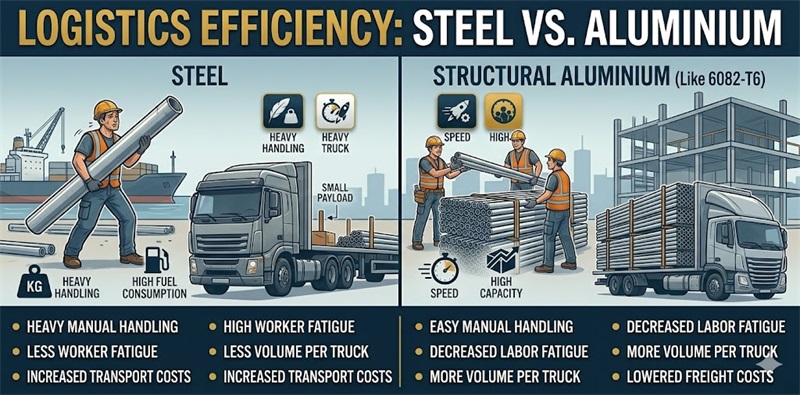
De l'inspection initiale à la réception des travaux d'un bâtiment, le poids des matériaux peut avoir un impact considérable. Le facteur le plus important est la densité inférieure de l'aluminium par rapport à l'acier. La densité de l'aluminium est sensiblement équivalente à celle du bâtiment et des éléments logistiques associés. Les tubes en aluminium présentent plusieurs avantages par rapport à leurs alternatives en acier. Leur densité est de 2,7 g/cm³.3 par rapport à 7,85 g/cm3 Pour l'acier. Cet avantage de poids est encore plus marqué lorsque l'aluminium et l'acier sont extrudés en tubes structuraux. Ce type de fabrication illustre clairement les avantages considérables de l'aluminium par rapport à l'acier pour les applications structurelles.
Lourd échafaudage en acier Le transport des tubes sur le site nécessite une grande quantité de carburant. Compte tenu de leur nature, les produits transportés sont généralement livrés par camions plateaux poids lourds, ce qui implique de multiples livraisons par différents véhicules. Les tubes d'échafaudage en aluminium sont extrêmement légers, permettant ainsi de transporter un volume important de produits par un seul camion et de s'affranchir des limitations de poids. Cela permettra non seulement de réduire les coûts de transport, mais aussi les émissions de carbone liées à l'opération.
Le montage d'échafaudages est une tâche très exigeante en main-d'œuvre. Le levage de lourds poteaux en acier pendant des heures est éprouvant pour les travailleurs, entraînant fatigue, ralentissement du rythme de travail et risque accru de troubles musculo-squelettiques. Les tubes en aluminium, quant à eux, sont faciles à manipuler par une équipe réduite, ce qui permet de maintenir la motivation des travailleurs et de limiter les arrêts de travail liés aux blessures.
Dans le secteur de la construction, le temps, c'est de l'argent. Tout retard dans le montage des échafaudages retarde les travaux des corps de métier suivants, comme la peinture, le bardage ou les travaux d'électricité.
[Livraison sur site] ➔ [Manutention manuelle plus rapide] ➔ [Assemblage par emboîtement rapide] ➔ [Réduction du temps total de projet]
Grâce à sa légèreté, l'échafaudage tubulaire en aluminium permet un montage et un démontage rapides.
Pas besoin de machinerie lourde : contrairement aux imposantes structures en acier qui peuvent nécessiter des grues ou des palans mécaniques pour positionner de grandes sections, les tours en aluminium peuvent souvent être érigées manuellement.
Assemblage efficace des composants : Les systèmes d’échafaudage modernes en aluminium utilisent des joints et des raccords modulaires de précision. La légèreté des tubes permet aux monteurs d’emboîter, de verrouiller et de sécuriser les connexions beaucoup plus rapidement qu’avec les méthodes traditionnelles utilisant des tubes et des colliers en acier lourds.
Des études montrent que les tours d'échafaudage en aluminium peuvent être érigées jusqu'à 50 % plus rapidement que leurs homologues en acier, permettant ainsi aux projets de passer rapidement de la phase de préparation à l'exécution active.
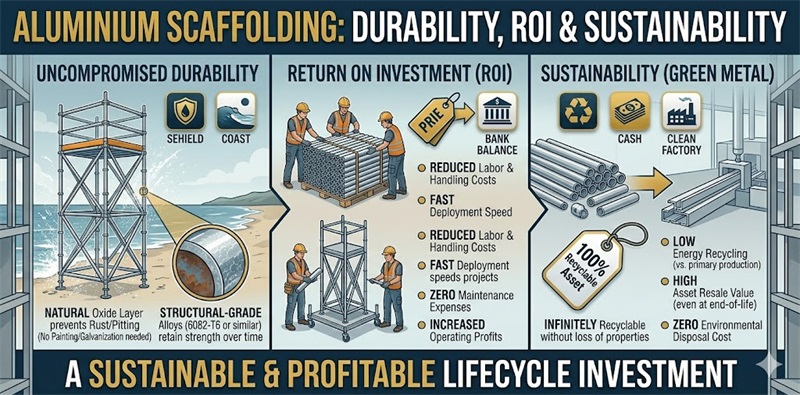
Les échafaudages sont régulièrement exposés à des conditions environnementales difficiles : pluies torrentielles, forte humidité, températures fluctuantes et, dans les régions côtières, embruns salés.
Au contact de l'oxygène et de l'humidité, l'acier brut s'oxyde et forme de l'oxyde de fer (rouille). La rouille s'écaille, exposant continuellement le métal à la corrosion, ce qui compromet à terme l'intégrité structurelle des tubes d'échafaudage. Pour pallier ce problème, l'acier nécessite une galvanisation poussée ou une peinture régulière.
L'aluminium, en revanche, forme naturellement une couche d'oxyde microscopique et très protectrice au contact de l'air. Cette couche est auto-réparatrice ; si la surface est rayée, elle se reforme instantanément.
Avantage clé : Les échafaudages tubulaires en aluminium ne rouillent pas, ne se piquent pas et ne s’écaillent pas. Ils peuvent être stockés en extérieur pendant des années, même dans des zones à forte humidité ou en bord de mer, sans perdre de leur résistance structurelle, ce qui garantit une durée de vie nettement plus longue et des coûts d’entretien réduits.
On croit souvent, à tort, que l'aluminium, du fait de sa légèreté, manque de résistance pour les applications de construction lourdes. C'est un mythe que la science des matériaux réfute.
Les échafaudages modernes en aluminium utilisent des alliages structuraux à haute résistance (généralement de la série 6000, tels que le 6061-T6 ou le 6082-T6). Ces alliages subissent un traitement thermique spécifique afin d'optimiser leurs propriétés mécaniques.
Propriété matérielle | Acier de construction | Aluminium structurel (6082-T6) |
Comparaison des poids | Valeur de référence (100 %) | ~66% plus léger |
résistance à la corrosion | Faible (Nécessite une galvanisation) | Exceptionnellement élevé (couche d'oxyde naturel) |
Flexibilité / Élasticité | Rigide, sujet à une déformation permanente | Une élasticité plus élevée absorbe bien les chocs |
Résistance aux étincelles | Risque d'étincelles de friction | Anti-étincelles (Sans danger pour les environnements dangereux) |
De plus, les systèmes d'échafaudages tubulaires en aluminium sont conçus avec rigueur pour répondre aux normes de sécurité internationales les plus strictes, telles que la norme EN 1004 (pour les tours d'accès mobiles) et les réglementations de l'OSHA. Ils offrent des plateformes stables et rigides capables de supporter en toute sécurité les travailleurs, les outils lourds et les matériaux.
Au-delà des chantiers de construction classiques, certains secteurs d'activité présentent des risques spécifiques où les échafaudages métalliques traditionnels constituent un danger direct. L'aluminium tubulaire excelle dans ces environnements particuliers à haut risque.
Bien que le coût d'achat initial des échafaudages tubulaires en aluminium de haute qualité soit supérieur à celui de l'acier brut ou galvanisé, les calculs financiers à long terme racontent une tout autre histoire.
Investissement initial élevé ➔ Maintenance nulle + Coûts de main-d'œuvre réduits + Valeur de revente maximale = Coût total de possession (CTP) réduit
Aucun coût d'entretien : aucun sablage, aucune peinture ni aucun traitement antirouille n'est nécessaire pendant toute la durée de vie d'un tube en aluminium.
Valeur de revente élevée : l’aluminium de récupération conserve une part importante de sa valeur initiale. Même en fin de vie, les échafaudages en aluminium restent un matériau précieux et entièrement recyclable.
Indicateurs de durabilité : L’aluminium est reconnu comme le « métal vert ». Il est recyclable à l’infini sans perte de propriétés et ne nécessite que 5 % de l’énergie nécessaire à la production de métal primaire. Son utilisation est en parfaite adéquation avec les certifications de bâtiments écologiques modernes et les objectifs de développement durable des entreprises.
Alors que l'acier de construction est conçu pour supporter des charges importantes et des maçonneries haute densité (classe 4 et plus), les échafaudages en aluminium de construction sont parfaitement adaptés aux applications légères à moyennes (jusqu'à la classe 3, supportant jusqu'à 200 kg/m²).2Il est hautement optimisé pour l'accès, le revêtement, la maintenance, la peinture et les travaux MEP.
Non. Les alliages d'aluminium structuraux comme le 6082-T6 possèdent une résistance à la traction et une limite d'élasticité élevées. Ils sont conçus pour supporter des charges structurelles avec un coefficient de sécurité intégré. En effet, l'aluminium a un module d'élasticité inférieur à celui de l'acier, ce qui signifie qu'il peut absorber les chocs et fléchir légèrement sans subir de déformation permanente ni de rupture structurelle.
Nos systèmes d'échafaudages tubulaires sont commercialisés depuis de nombreuses années. Dans un secteur du bâtiment où la rentabilité est primordiale, nous sommes convaincus que nos systèmes d'échafaudages légers, robustes et durables constituent une solution polyvalente et économique, aussi bien pour le chef de projet que pour le responsable sécurité et le directeur financier.
À l'avenir, les échafaudages en aluminium permettront de réduire les coûts de main-d'œuvre et de transport, et surtout, de créer des lieux de travail plus sûrs.
Que vous gériez un important projet d'expansion d'infrastructure, cherchiez à optimiser votre parc de location commerciale ou à vous procurer des équipements à haute durabilité pour la maintenance industrielle, le passage à des échafaudages tubulaires en aluminium de qualité supérieure est la clé pour atteindre de nouveaux niveaux d'efficacité opérationnelle.
Contactez notre équipe d'assistance technique dès aujourd'hui pour demander un devis personnalisé, consulter les spécifications structurelles ou explorer notre vaste gamme de solutions d'échafaudage modulaires en aluminium.
E-mail : aj-steven@dghualifeng.com.cn


Friendly Links :
Kitchen Cabinet© 2026 Guangzhou AJ matériaux de construction Co., Ltd Tous les droits sont réservés

 en
en fr
fr es
es