Résistance des tuyaux ronds vs résistance des tuyaux carrés : la comparaison structurelle ultime
May 18, 2026Dans la gestion d'un projet industriel, le choix du profil structurel approprié est une décision cruciale qui influe sur la sécurité, le budget et la pérennité. Parmi les différentes options, le débat entre résistance des tuyaux ronds par rapport à la résistance des tuyaux carréselle représente un défi fondamental pour les ingénieurs, les entrepreneurs et les équipes d'approvisionnement en matériaux.
Bien que les deux formes soient des outils indispensables dans la construction, les infrastructures et échafaudageIls possèdent des propriétés mécaniques distinctes. Choisir au hasard peut conduire à un surdimensionnement structurel (gaspillage d'argent) ou à un sous-dimensionnement (compromis à la sécurité).
Ce guide complet décortique la science de la résistance structurelle entre tuyaux ronds et carrés, en évaluant leurs performances sous différentes charges afin que vous puissiez prendre une décision éclairée et basée sur les données pour votre prochain projet.
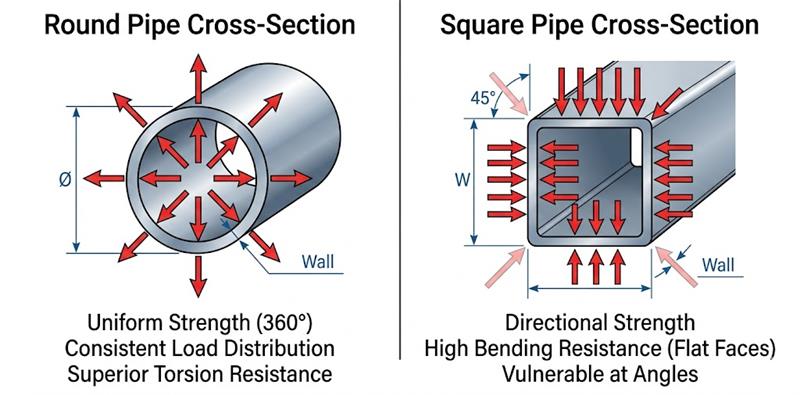
Avant d'aborder des applications concrètes, il est essentiel de comprendre que la « résistance » en génie des structures ne se résume pas à un seul critère. La capacité d'un matériau à résister à la rupture dépend fortement de la géométrie de sa section transversale et du type de force qui lui est appliquée.
Deux concepts d'ingénierie essentiels régissent cette comparaison :
Parce qu'un tuyau rond répartit sa masse symétriquement autour d'un axe central, il réagit différemment aux forces qu'un tuyau carré, dont la masse est concentrée plus loin du centre, le long de ses côtés plats et de ses coins.
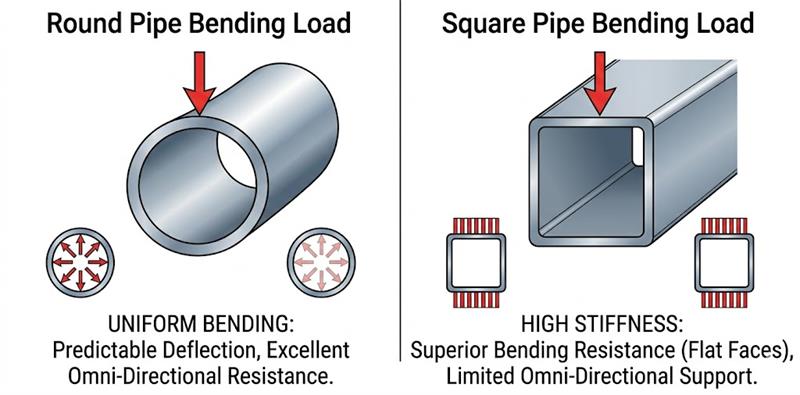
Lorsqu'une poutre ou un tuyau est soumis à une charge perpendiculaire, il se déforme. Ce phénomène est courant dans les poutres de support, les charpentes et les ponts.
Si une charge est appliquée directement à partir d'une seule direction perpendiculaire (par exemple, verticalement vers le bas sur une poutre horizontale), les tubes carrés offrent généralement une résistance à la flexion supérieure à celle des tubes ronds de poids ou de section transversale équivalents.
Alors qu'un tuyau carré excelle lorsqu'il est chargé à plat, il perd considérablement de sa résistance si la charge le frappe en diagonale (à un angle de 45 degrés par rapport à ses coins).
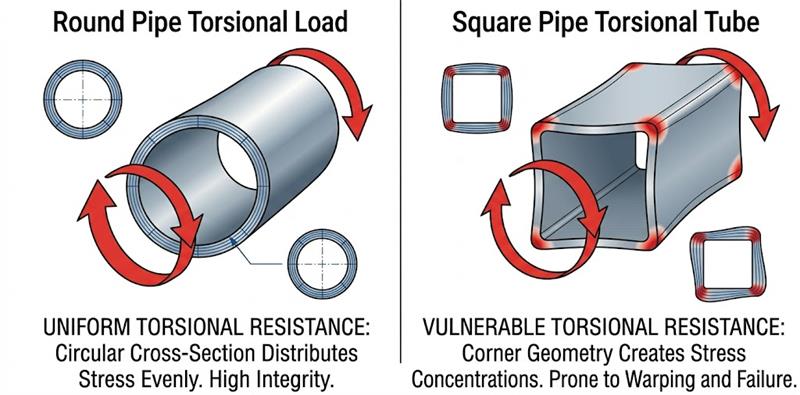
La torsion se produit lorsqu'un couple ou une force de torsion est appliqué(e) le long de l'axe longitudinal du tuyau. Pensez aux arbres de transmission, aux tours d'éoliennes ou aux structures d'échafaudage soumises à des contraintes de rotation.
En matière de résistance aux forces de torsion, les tuyaux ronds sont fondamentalement supérieurs aux tuyaux carrés.
La compression axiale se produit lorsqu'une charge s'exerce vers le bas depuis le haut d'une colonne verticale, comme un pilier de soutien ou un montant d'échafaudage. Le principal mode de défaillance est le flambement, où la colonne se courbe vers l'extérieur et s'effondre sous le poids.
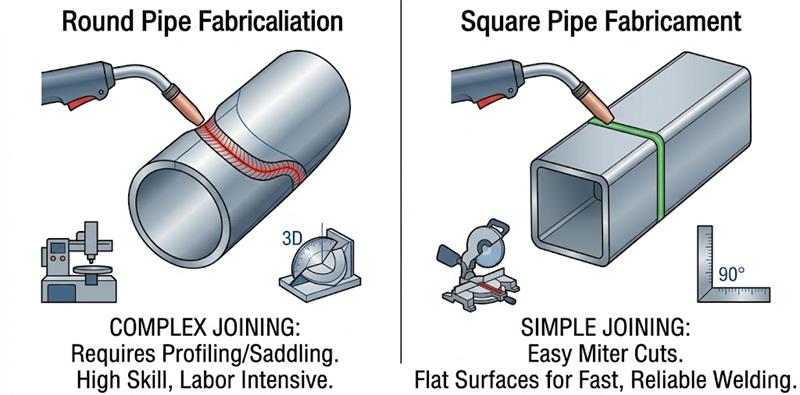
Dans la réalité, le choix d'un profil de tuyau nécessite de trouver un équilibre entre la robustesse théorique en ingénierie et la mise en œuvre pratique sur le terrain.
Métrique d'évaluation | Tuyau rond | Tuyau carré |
Rapport résistance/poids (torsion) | Excellent | Pauvre |
Rapport résistance/poids (flexion directe) | Modéré | Excellent |
Facilité de soudage et d'assemblage | Complexe (Nécessite un profilage/un sellage) | Facile (Coupes droites et coutures plates) |
Utilisation de l'espace / Stockage | Mauvaise qualité (Laisse des espaces vides lorsqu'ils sont empilés) | Excellent (Chasse bien étanche) |
Aérodynamique (Résistance au vent/aux fluides) | faible coefficient de traînée | coefficient de traînée élevé |
Les tubes carrés, grâce à leurs surfaces planes, sont extrêmement faciles à couper, à aligner, à boulonner et à souder. Cela réduit considérablement les coûts de main-d'œuvre et le temps d'assemblage en usine ou sur les chantiers. À l'inverse, les tubes ronds nécessitent des opérations de profilage ou de coupe en biseau spécifiques pour un assemblage précis aux angles, ce qui exige une plus grande expertise en soudage et un équipement spécialisé.
Pour les infrastructures extérieures, la résistance au vent est un facteur essentiel. Les tuyaux ronds permettent au vent de s'écouler en douceur autour de leurs profils incurvés, réduisant considérablement la résistance au vent. Les tuyaux carrés, quant à eux, agissent comme des voiles, captant le vent et augmentant la contrainte latérale sur l'ensemble des fondations.
Pour optimiser l'efficacité, examinons comment ces atouts se traduisent dans des applications industrielles standard :
Dans le duel de résistance entre les tuyaux ronds et les tuyaux carrés, il n'y a pas de vainqueur universel ; il n'y a que l'outil adapté à la tâche spécifique.
Choisissez le tube carré si votre projet exige une haute résistance au cintrage en ligne droite, une fixation sur surface plane et privilégie un soudage et une fabrication rapides et économiques.
Choisissez un tuyau rond si votre structure doit résister à de fortes forces de torsion, a besoin d'une résistance constante à 360 degrés face à des forces environnementales imprévisibles ou implique le transport de fluides sous pression.
Un tuyau rond est-il plus résistant qu'un tuyau carré de même poids ?
Quel profil de tuyau est le plus rentable à fabriquer ?
L'épaisseur de la paroi affecte-t-elle différemment les tuyaux ronds et carrés ?
E-mail : aj-steven@dghualifeng.com.cn


Friendly Links :
Kitchen Cabinet© 2026 Guangzhou AJ matériaux de construction Co., Ltd Tous les droits sont réservés


 en
en fr
fr es
es