Le guide ultime de la construction par coffrage glissant : efficacité, retour sur investissement et meilleures pratiques pour les infrastructures modernes
Jun 25, 2026Dans le secteur de la construction en béton à grande échelle, le temps, c'est de l'argent. Pour les chefs de projet, les ingénieurs civils et les entreprises de construction, le choix de la méthode de coffrage appropriée peut faire toute la différence entre un projet très rentable et un projet entaché de retards coûteux.
Parmi les méthodes les plus efficaces disponibles aujourd'hui pour les structures en béton verticales et horizontales, on trouve construction à coffrage glissant.
Mais qu’est-ce que la construction par coffrage glissant exactement ? Comment offre-t-elle un retour sur investissement supérieur aux méthodes traditionnelles, et quand votre entreprise devrait-elle y recourir ? Ce guide complet détaille les mécanismes, les avantages et les points clés à prendre en compte concernant cette technologie de coulage continu.
construction à coffrage glissantLe coffrage glissant (parfois appelé coffrage coulant) est une méthode de coulage de béton en continu où le coffrage fait office de moule mobile. Au lieu d'attendre le durcissement complet du béton, de démouler et de réinstaller le moule pour la coulée suivante, le système de coffrage glissant se déplace en continu vers le haut (ou horizontalement) à une vitesse constante.
Le coffrage est généralement levé par des vérins hydrauliques qui s'appuient sur des barres d'armature verticales en acier. Au fur et à mesure de son déplacement, le coffrage laisse derrière lui un béton ayant acquis une intégrité structurelle suffisante pour supporter son propre poids et celui du béton frais coulé par-dessus.
Selon la nature de votre projet, le coffrage glissant se divise généralement en deux catégories :
Pour comprendre pourquoi cette méthode est si prisée des professionnels de la construction B2B, il est utile de comprendre le cycle synchronisé d'une opération standard de coffrage glissant vertical :
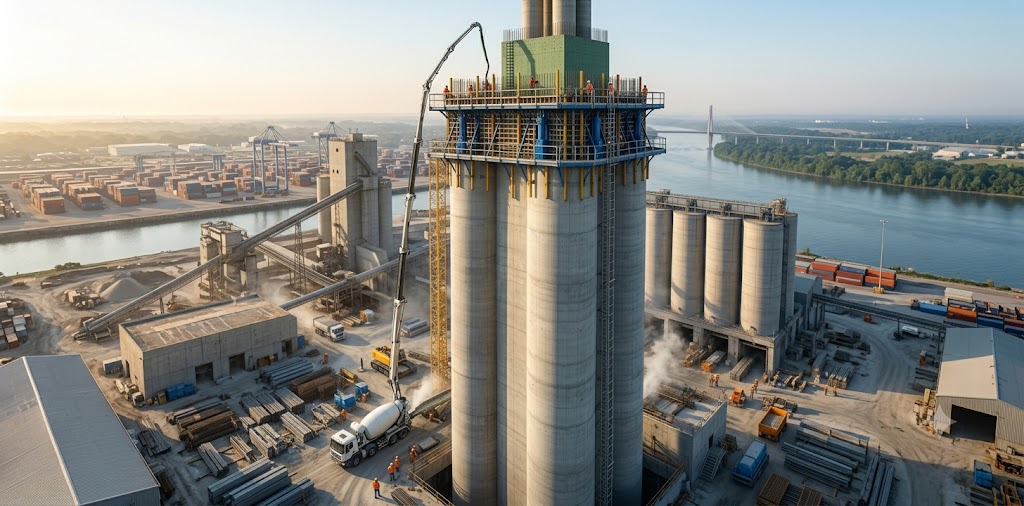
Pour les entreprises de construction et les promoteurs d'infrastructures, le choix d'un système de coffrage implique de trouver un équilibre entre les coûts de mobilisation initiaux et les économies à long terme sur le chantier. Voici pourquoi le coffrage glissant est souvent l'option la plus rentable pour les grands projets :
Les coffrages glissants traditionnels ou les coffrages en bois nécessitent le coulage, le durcissement, le décoffrage, le nettoyage et la remise en place. Ce cycle peut prendre plusieurs jours par étage ou par levée. Le coffrage glissant élimine totalement les temps morts. En fonctionnant en continu, des structures comme des silos ou des noyaux de gratte-ciel peuvent s'élever par paliers. 3 à 6 mètres par jour, raccourcissant considérablement le chemin critique du calendrier du projet.
Comme le béton est coulé en continu, la construction par coffrage glissant réduit considérablement, voire élimine, les risques liés à la mise en place du béton. joints de construction(joints froids). Il en résulte une structure en béton monolithique et homogène, offrant une étanchéité supérieure, une résistance accrue aux intempéries et une excellente répartition des charges. C'est un atout majeur pour des projets tels que les réservoirs de stockage de liquides, les silos et les ouvrages maritimes.
Bien que le coffrage glissant exige des superviseurs hautement qualifiés, il réduit la main-d'œuvre nécessaire au démontage et au remontage des coffrages traditionnels. De plus, grâce à l'intégration des plateformes de travail et des garde-corps au système auto-grimpant, le risque de chute de hauteur est considérablement réduit par rapport aux échafaudages classiques.
Grâce à un système de coffrage fixe et réutilisable, les déchets de bois sur chantier sont quasiment éliminés. La livraison des matériaux (béton et barres d'armature) est planifiée à un rythme régulier et prévisible, ce qui réduit l'encombrement sur les chantiers urbains exigus et permet une gestion plus efficace de la chaîne d'approvisionnement.
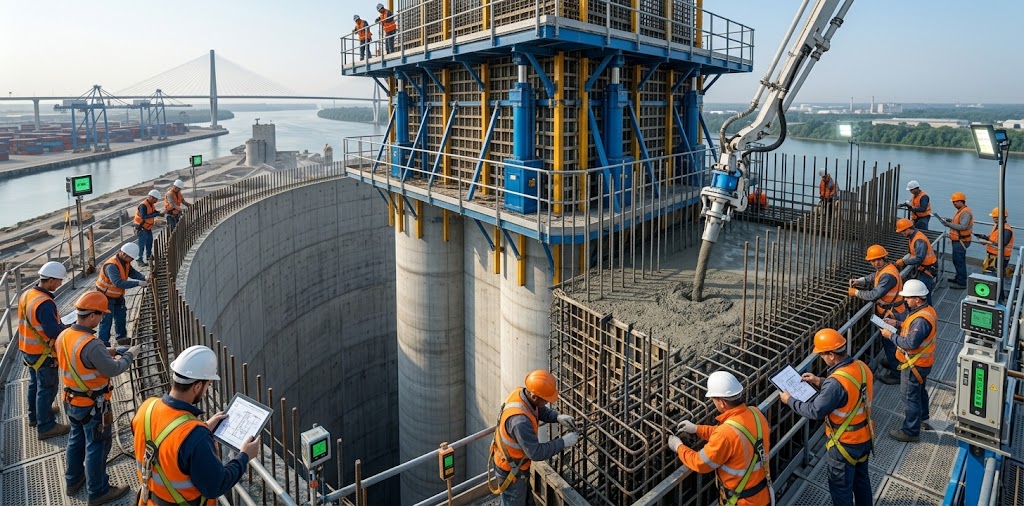
Malgré ses avantages financiers et opérationnels considérables, la construction par coffrage glissant est une science rigoureuse. Les décideurs B2B doivent évaluer plusieurs facteurs critiques avant le déploiement :
La réussite d'un coulage en coffrage glissant dépend fortement de la chimie du béton. Le mélange doit rester suffisamment maniable pour être mis en place et vibré, tout en prenant assez rapidement pour supporter la structure dès sa sortie du moule. Les entrepreneurs doivent surveiller de près :
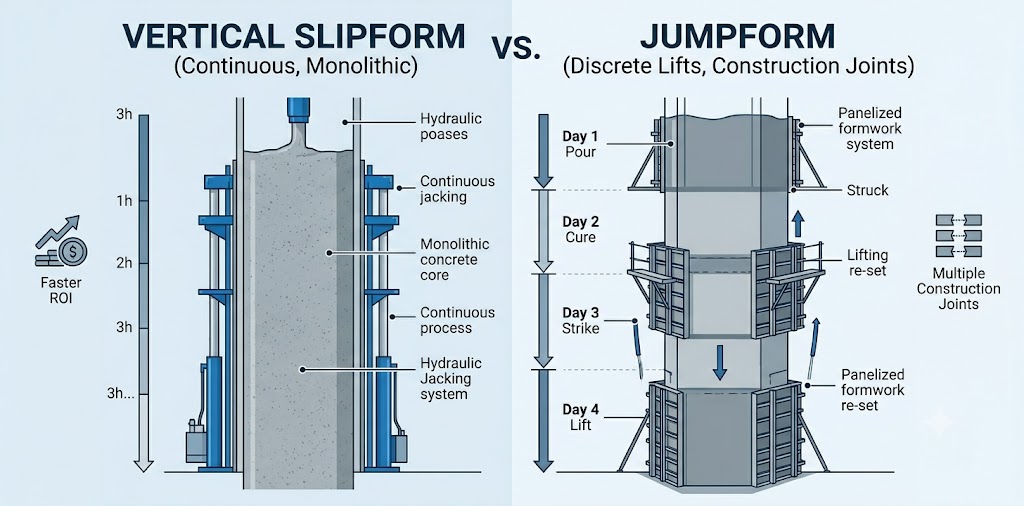
Fonctionnalité | Construction par coffrage glissant | Forme de saut / Forme d'escalade | Forme traditionnelle en bois/panneaux |
Mouvement | Continu (lent et régulier) | Ascenseurs intermittents (par paliers) | Gâcher et redresser manuellement |
Rapidité de la construction | Extrêmement rapide (3 à 6 m/jour) | Modéré (1 séance de musculation tous les quelques jours) | Lent |
Joints de construction | Aucun à minimal | Fréquent (À chaque ascenseur) | Haut |
Investissement initial en capital | Haut | Moyen-élevé | Faible |
Profil de projet idéal | Structures hautes et uniformes (silos, noyaux) | Immeubles résidentiels/commerciaux de grande hauteur | Géométrie complexe de faible hauteur |
La construction par coffrage glissant représente le summum de l'efficacité en ingénierie du béton. Pour les entreprises de construction, les promoteurs d'infrastructures et les fournisseurs de matériaux cherchant à accroître leur productivité, elle offre une méthode éprouvée pour réduire les délais de réalisation des projets, diminuer les coûts de main-d'œuvre à long terme et livrer des structures d'une résistance monolithique supérieure.
Bien qu'elle exige une planification méticuleuse, une gestion précise du mélange de béton et un investissement initial plus élevé, la rentabilité obtenue grâce à des délais raccourcis et à des frais généraux sur site minimisés en fait un choix imbattable pour la bonne catégorie d'actifs.
Vous prévoyez votre prochain projet de construction d'immeuble de grande hauteur ou d'infrastructure ? Choisir la bonne stratégie de coffrage peut optimiser votre budget et garantir le respect de vos délais.
[Contactez notre équipe d'ingénieurs dès aujourd'hui] pour demander une consultation technique complète et découvrir comment nos solutions de coffrage haut de gamme peuvent simplifier votre prochain chantier.
E-mail : aj-steven@dghualifeng.com.cn


Friendly Links :
Kitchen Cabinet© 2026 Guangzhou AJ matériaux de construction Co., Ltd Tous les droits sont réservés


 en
en fr
fr es
es