Guide ultime des systèmes d'échafaudage : avantages, inconvénients et comment choisir
May 21, 2026
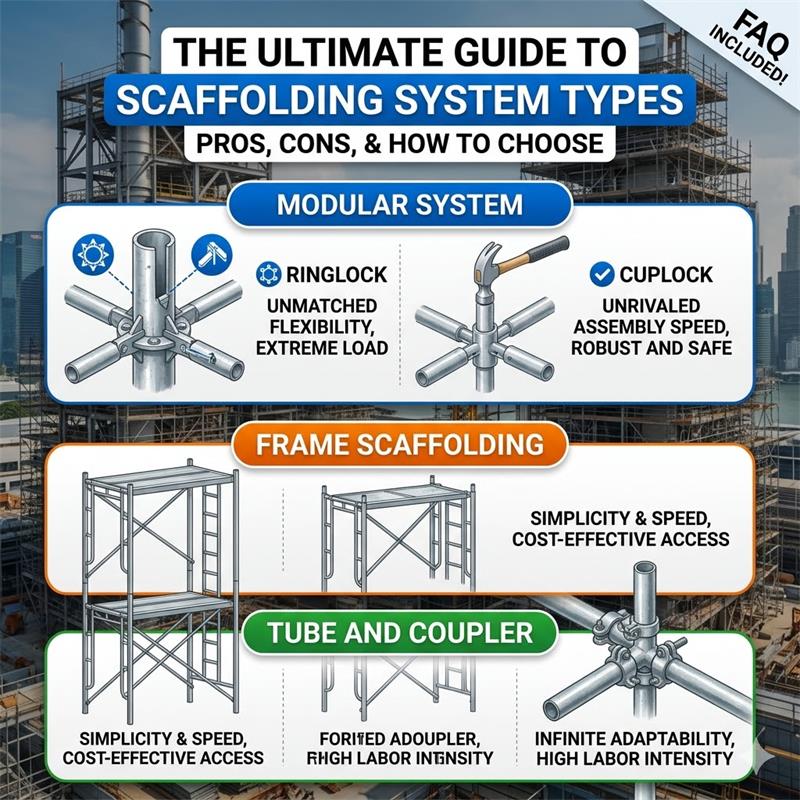
Ces dernières années, les systèmes d'échafaudage ont évolué pour répondre à trois objectifs principaux : la sécurité des travailleurs, l'augmentation de la productivité et la stabilité de l'échafaudage face aux influences environnementales extérieures et aux différentes charges. Qu'il s'agisse d'un immeuble de grande hauteur, d'une installation industrielle comme une raffinerie ou de travaux de maintenance d'infrastructures, l'échafaudage constitue la base de sécurité temporaire pour les travailleurs.Les structures de construction temporaires sont utilisées dans le secteur du bâtiment partout dans le monde. Choisir l'échafaudage adapté à un projet peut s'avérer long et complexe, notamment en raison du temps nécessaire à sa mise en place. Ce processus engendre également des coûts supplémentaires importants et pose de nombreux problèmes au chef de projet. En effet, il ralentit le chantier, car les équipes doivent veiller à la sécurité du personnel supplémentaire requis pour mener à bien les travaux.Dans ce guide, nous examinerons les mécanismes des systèmes d'échafaudage temporaires disponibles dans le monde entier, nous décrirons leurs avantages et leurs inconvénients, et nous passerons également en revue leurs domaines d'application afin de vous aider à décider s'il vaut mieux acheter un système d'échafaudage ou en louer un. Échafaudage modulaire (système) Les systèmes d'échafaudage modulaires, également connus sous le nom de échafaudage du systèmeCes échafaudages sont généralement constitués de montants préfabriqués (poteaux) et de tirants correspondants, ainsi que d'autres éléments assemblés à des points de fixation fixes. Ce type d'accès tend à se généraliser sur les grands chantiers du monde entier, notamment grâce à sa rapidité de construction et à sa capacité de charge élevée, supérieures à celles des autres méthodes d'accès.Parmi tous les systèmes d'échafaudage utilisés dans le monde, les deux systèmes les plus populaires sur le marché mondial sont les suivants : Système d'échafaudage Ringlock Le système Ringlock est très apprécié pour sa polyvalence et sa rapidité. Sa caractéristique principale est une rosace circulaire soudée sur le montant vertical tous les 500 mm, permettant de connecter jusqu'à huit éléments (entretoises et contreventements) selon différents angles grâce à un mécanisme de goupille de verrouillage sécurisé.Avantages:Flexibilité inégalée :La conception en rosace à 360 degrés permet une géométrie précise, ce qui la rend idéale pour les structures courbes, les réservoirs industriels circulaires et les façades complexes.Capacité de charge élevée :Les composants en acier robuste répartissent efficacement les poids, répondant ainsi aux exigences importantes en matière d'étaiement et d'échafaudage.Durabilité:Généralement galvanisé à chaud pour résister à la corrosion dans les environnements côtiers ou industriels difficiles.Inconvénients :Investissement initial plus élevé :La précision de fabrication requise pour les rosaces et les cales augmente les coûts d'acquisition initiaux par rapport aux systèmes de cadres de base.Idéal pour :Raffineries de pétrole et de gaz, construction navale, infrastructures complexes et génie civil industriel lourd. Système d'échafaudage Cuplock Cuplock est un autre système modulaire utilisé dans le monde entier. Il utilise un mécanisme de verrouillage unique en forme de « coupelle », où une coupelle inférieure fixe et une coupelle supérieure coulissante se verrouillent simultanément sur quatre axes horizontaux par un seul coup de marteau.Avantages :Assemblage rapide :Son mécanisme de verrouillage unique à action unique en fait l'un des systèmes les plus rapides à monter et à démonter, réduisant considérablement le temps de travail.Robuste et sûr :Aucun élément de fixation ou cale susceptible de se perdre sur site, ce qui minimise les risques liés à la maintenance et à la sécurité.Inconvénients :Angles rigides :Les raccords sont limités à des angles fixes de 90 degrés, ce qui le rend moins adaptable aux profils architecturaux très irréguliers ou courbes.Idéal pour : Étaiements en béton armé, construction de ponts et façades d'immeubles de grande hauteur simples. Échafaudage à ossature (Modulaire / Sectionnel) L'échafaudage à ossature métallique est le type d'échafaudage temporaire le plus répandu, largement utilisé dans les secteurs commercial et résidentiel en Amérique du Nord et dans certaines régions d'Asie. Il est constitué de cadres préfabriqués en acier ou en aluminium soudés, reliés par des entretoises transversales pour former des tours rigides.Avantages :Simplicité et rapidité :Les cadres légers peuvent être empilés et verrouillés verticalement par une main-d'œuvre non qualifiée, sans formation complexe.Rentable :Des coûts d'achat et de location initiaux plus faibles le rendent très accessible aux entrepreneurs généraux.Accès facile :Il comporte souvent des échelles intégrées ou des arches de passage, facilitant ainsi le déplacement des travailleurs transportant des matériaux.Inconvénients :Hauteur et charge limitées : Non conçu intrinsèquement pour supporter des charges industrielles extrêmement lourdes ou des hauteurs extrêmes sans renforcement structurel massif.Manque de flexibilité :Ne peut s'adapter à des formes complexes ; il est strictement linéaire.Idéal pour : Maçonnerie, travaux de brique extérieure, peinture, plâtrage et entretien de bâtiments de faible à moyenne hauteur. Échafaudages tubulaires et raccordés Souvent appelée échafaudage « à tubes et clips » ou « à tuyaux libres », cette méthode traditionnelle repose sur deux éléments principaux : des tubes en acier ou en aluminium et différents types de raccords (pivotants, à angle droit et à manchon).Avantages :Adaptabilité infinie :L'absence de points de fixation fixes permet de couper et de fixer les tubes à n'importe quelle hauteur, profondeur ou angle. Ce système s'adapte ainsi à pratiquement toutes les anomalies structurelles.Faible coût des matériaux :Les tubes en acier brut et les colliers de serrage robustes sont relativement peu coûteux à l'achat.Inconvénients :À forte intensité de main-d'œuvre : L'assemblage nécessite des monteurs d'échafaudages hautement qualifiés et certifiés pour mesurer, aligner et boulonner manuellement chaque nœud. Les temps de montage sont nettement plus longs que ceux des systèmes modulaires.Taux de perte élevé :Sur les chantiers de construction très fréquentés, les petites pièces détachées comme les raccords se perdent facilement, ce qui augmente les coûts de remplacement au fil du temps.Idéal pour :Restaurations historiques aux formes irrégulières, espaces restreints autour de tuyauteries industrielles complexes et projets où les composants modulaires ne peuvent physiquement pas s'intégrer. Échafaudages suspendus (plateformes pivotantes) Contrairement aux options précédentes reposant sur le sol, l'échafaudage suspendu comporte une plateforme suspendue à une structure aérienne (généralement des toits ou des parapets) à l'aide de câbles en acier robustes et de palans électriques.Avantages :Portée verticale illimitée :Idéal pour les structures de très grande hauteur où l'installation d'échafaudages sur socle serait financièrement et structurellement impossible.Empreinte au sol minimale :Maintient les trottoirs et les niveaux du sol complètement dégagés pour la circulation piétonne ou d'autres opérations de construction.Inconvénients :Vulnérabilités de sécurité strictes :Très sensibles aux vents violents. Des défaillances mécaniques mineures au niveau des monte-charges peuvent engendrer des risques catastrophiques pour la sécurité, exigeant des inspections quotidiennes rigoureuses et des systèmes antichute.Idéal pour :Nettoyage de vitres, réparation de façades, peinture d'immeubles de grande hauteur et pose de vitres sur les gratte-ciel. Matrice de comparaison complète Pour résumer la façon dont ces systèmes se comparent, consultez le tableau comparatif ci-dessous :Type d'échafaudageVitesse d'assemblageCapacité de chargeFlexibilité / AdaptabilitéExigences en matière de compétences de la main-d'œuvreRentabilité (à long terme)Ringlock modulaireTrès rapideÉlevé à extrêmeExcellent (angles à 360°)MoyenHaute qualité (durable et rapide)Cuplock modulaireTrès rapideHautModéré (90° seulement)MoyenÉlevé (faible entretien)Échafaudage à ossatureRapideFaible à moyenFaible (linéaire uniquement)FaibleIdéal pour les travaux légersTube et raccordLentMoyenInfiniTrès élevéFaibles (Coûts de main-d'œuvre élevés)SuspenduN/A (vue de haut en bas)Faible (Plateforme uniquement)SpécialiséNiveau élevé (axé sur la sécurité)Haut pour les gratte-ciel Facteurs clés à prendre en compte avant de choisir votre système Pour optimiser la sécurité et la rentabilité de votre projet, évaluez les exigences de votre projet en fonction de ces indicateurs clés :Géométrie du projet :Les façades planes et linéaires sont privilégiées pour les systèmes Frame ou Cuplock. Les structures courbes, les supports de tuyauterie industriels complexes ou les structures circulaires nécessitent des systèmes Ringlock ou Tube et Coupler.Attentes en matière de charge :Si votre équipe manipule de lourdes dalles de béton, de grandes palettes de briques ou du matériel de maçonnerie lourd, optez pour des systèmes modulaires robustes. Pour la maintenance légère, les systèmes à châssis ou suspendus sont idéaux.Marché du travail local et coûts :Si les échafaudeurs qualifiés sont rares ou chers dans votre région, l'utilisation de systèmes modulaires comme Ringlock peut réduire considérablement les heures de travail, compensant ainsi le coût initial plus élevé des composants.Transport et stockage :Les composants modulaires s'empilent facilement, optimisant l'espace des conteneurs d'expédition et réduisant les problèmes de gestion logistique. Conclusion et prochaines étapes concrètes Il n'existe pas de système d'échafaudage « idéal » ; il n'existe que le système adapté aux contraintes spécifiques de votre projet. L'équilibre entre les normes de sécurité structurelle, la rapidité de montage et le coût du matériel déterminera si vous optez pour la flexibilité avancée d'un système d'échafaudage. Ringlock, la simplicité rapide des systèmes à cadre, ou l'adaptabilité traditionnelle de Tube et coupleur.Consacrer du temps à la sélection du matériel de scène approprié garantit une productivité accrue des travailleurs, une conformité réglementaire absolue et des marges de projet protégées. Prêt à optimiser votre prochain chantier ? Que vous augmentiez votre stock pour un important appel d'offres municipal, que vous développiez votre flotte de location ou que vous recherchiez du matériel fiable pour un projet de construction commerciale à venir, choisir le bon partenaire est essentiel.[Contactez dès aujourd'hui nos experts en ingénierie et en équipement] pour une évaluation complète de votre projet, des calculs de charge détaillés et des devis compétitifs adaptés précisément à vos besoins opérationnels. FAQ Quelle est la principale différence structurelle entre les échafaudages modulaires et les échafaudages traditionnels à tubes et raccords ?L'échafaudage modulaire utilise des éléments verticaux et horizontaux préfabriqués qui s'emboîtent à intervalles réguliers (par exemple, par des rosaces ou des coupelles), garantissant des dimensions uniformes et un montage rapide. L'échafaudage traditionnel à tubes et raccords utilise des tubes non préfabriqués et des colliers indépendants, permettant d'assembler les éléments en tout point et sous tous les angles. Cette méthode offre une adaptabilité infinie, mais exige beaucoup plus de temps et de main-d'œuvre qualifiée.Pourquoi le système Ringlock est-il privilégié pour les projets industriels et pétroliers et gaziers ?Les environnements industriels présentent des configurations très irrégulières, notamment des cuves courbes, des réseaux de tuyauterie complexes et des machines lourdes. La conception en rosette à 360 degrés de Ringlock permet aux traverses et aux entretoises de se connecter selon des angles précis afin de s'enrouler en toute sécurité autour de ces obstacles. De plus, sa capacité de charge élevée et son revêtement galvanisé à chaud le protègent contre les environnements chimiques corrosifs.Comment les systèmes d'échafaudage à ossature se comparent-ils en termes de rapport coût-efficacité ?L'échafaudage à ossature métallique offre les coûts d'achat et de location initiaux les plus bas, ce qui le rend très économique pour les applications commerciales ou résidentielles simples, de faible à moyenne hauteur (comme le plâtrage ou la maçonnerie). Cependant, comme il ne s'adapte pas aux formes irrégulières et ne supporte pas de charges extrêmement lourdes, son retour sur investissement à long terme se limite aux projets linéaires standard.


 en
en fr
fr es
es