Hauteur maximale des tours d'échafaudage en aluminium : tout ce que vous devez savoir
Jan 23, 2026tours d'échafaudage en aluminium Les tours d'accès mobiles sont largement utilisées dans le secteur de la construction et de la maintenance, principalement en raison de leur légèreté, de leur grande flexibilité et de leur facilité et rapidité de montage. Ainsi, lors de travaux en hauteur, la hauteur maximale admissible d'une tour d'accès mobile en aluminium est souvent un facteur déterminant dans le choix du matériel. Cette hauteur est régie par les normes de sécurité, les conditions du chantier et la configuration de la tour. Il est essentiel de connaître ces limites afin de garantir la conformité aux réglementations et de minimiser les risques d'accidents sur le chantier. Ce guide vous fournira des informations sur les exigences de hauteur maximale, le coefficient de stabilité et les exigences de sécurité relatives aux tours d'accès mobiles.
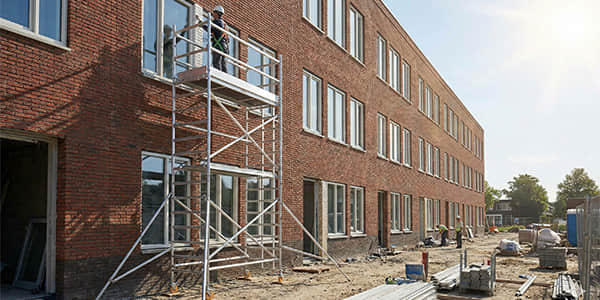
Lorsqu'on utilise des tours d'accès mobiles classiques construites conformément à la norme européenne EN1004, les valeurs maximales acceptables peuvent varier considérablement en fonction du type d'environnement présent.
TNormes typiques :
Il est essentiel de comprendre la différence entre les deux métriques les plus fréquemment définies dans les spécifications :
L'une des raisons de la réduction de la hauteur maximale des installations extérieures est la prise au vent. Une tour extérieure doit résister à la force du vent et à la force déstabilisatrice qui en résulte sur sa structure légère en aluminium. Afin de maintenir le centre de gravité de la tour suffisamment bas, la hauteur maximale autorisée est fixée à 8 m pour prévenir les accidents dus au basculement ou à la chute.
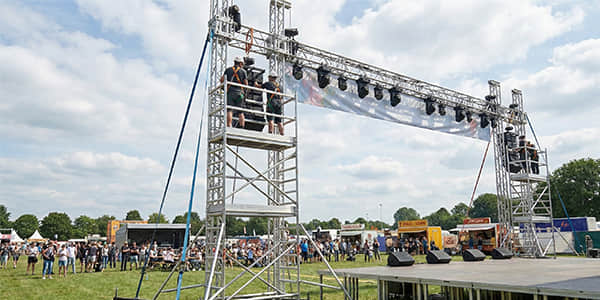
Le respect des normes établies est impératif pour des raisons de sécurité et de responsabilité. La norme principale régissant les antennes relais mobiles est la norme EN1004.
Les tours certifiées EN1004 répondent à des exigences rigoureuses en matière de matériaux, de dimensions et de capacité portante. Si un projet requiert des hauteurs supérieures aux limites standard de 12 m (intérieur) ou 8 m (extérieur), une configuration de tour mobile standard n'est plus suffisante.
Pour atteindre des hauteurs supérieures aux limites standard, la structure passe d'une « tour mobile » à une structure d'échafaudage complexe. Cela nécessite généralement :
La stabilité repose sur des principes physiques. Pour éviter qu'une tour isolée ne s'effondre, le rapport entre sa hauteur et la largeur de sa base doit être strictement respecté.
Lors de l'assemblage d'une tour à sa hauteur maximale autorisée, certains composants sont essentiels pour l'intégrité structurelle et la prévention des chutes.
Des structures triangulaires à la base de la tour augmentent la largeur de cette dernière. L'augmentation de la hauteur de la tour nécessite souvent un agrandissement des stabilisateurs ou un allongement de la distance entre la base et les points d'ancrage afin de compenser le déplacement du centre de gravité vers le haut.
Les chutes de hauteur et les chutes d'objets constituent des risques importants liés aux plateformes de travail en hauteur. La conformité de la construction de la tour nécessitera l'installation des dispositifs suivants :
Le montage doit toujours se faire selon la méthode 3T (par la trappe) ou à l'aide d'un système de garde-corps avancé (AGR). Ces méthodes garantissent la protection de l'opérateur par des garde-corps avant même qu'il ne monte sur la plateforme, éliminant ainsi le risque de chute pendant le montage.
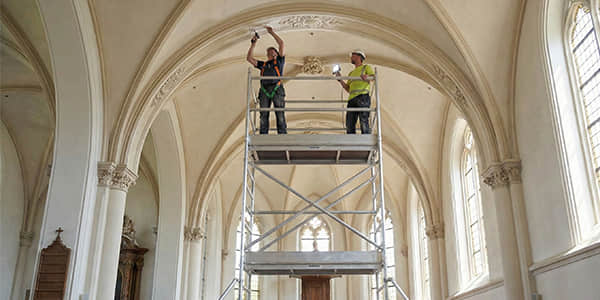
Garantir la sécurité ne se limite pas à l'équipement ; cela implique également une utilisation correcte.
La hauteur maximale d'un échafaudage en aluminium est une limite stricte définie pour des raisons de sécurité. Qu'il s'agisse d'utiliser les 12 mètres en intérieur ou de se limiter à 8 mètres en extérieur, le strict respect de la norme EN1004 et des recommandations du fabricant est la marque d'un travail professionnel. Un juste équilibre entre hauteur et stabilité garantit le bon déroulement des projets en toute sécurité.
Vous recherchez des solutions d'accès fiables ?
Veillez à ce que votre prochain projet respecte toutes les normes de sécurité et de performance. Contactez-nous dès aujourd'huipour discuter de notre gamme de tours en aluminium certifiées EN1004 et trouver la configuration adaptée à vos besoins spécifiques.
Quelle est la différence entre la hauteur de travail et la hauteur de la plateforme ?
Puis-je construire une tour d'échafaudage en aluminium de plus de 12 mètres de haut ?
À quelle hauteur dois-je utiliser des stabilisateurs (outriggers) ?
E-mail : aj-steven@dghualifeng.com.cn


Friendly Links :
Kitchen Cabinet© 2026 Guangzhou AJ matériaux de construction Co., Ltd Tous les droits sont réservés

 en
en fr
fr es
es